🏭The Factory in FactoryBox
The FactoryBox, although not producing a product itself, is designed to closely mimic current manufacturing layouts.
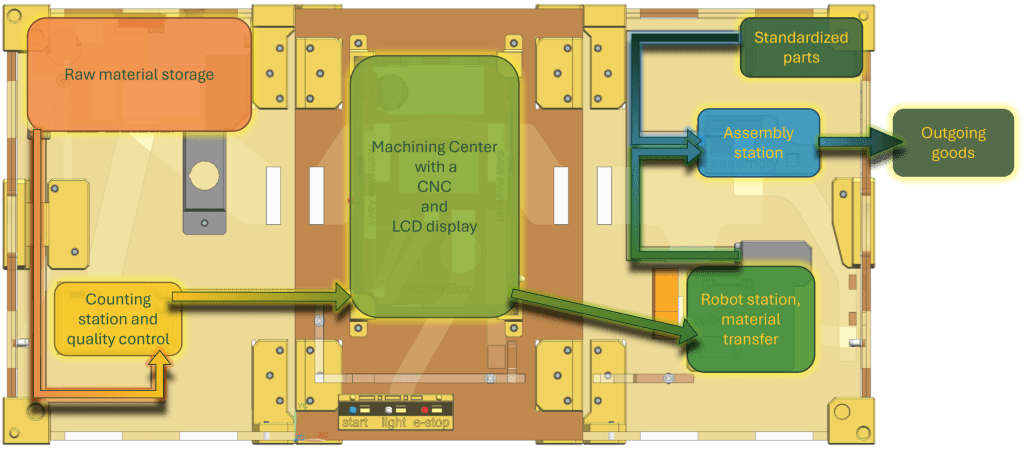
The layout below gives an overview over the whole Factory(Box).
In the following we will explain to you, how and why the production is mapped that way and the funtionalities and features you can expect to find in a modern factory.
We start with:
The production process begins in the incoming goods and quality control area. In a modern factory, all delivered materials are checked before they are cleared for production. Typical inspections include counting the delivered items, checking for visible defects, and verifying that the correct material type has been supplied. It is vital that the correct quantity of materials with the required quality enters the manufacturing process to avoid higher lost cost later-on in the process.
In the FactoryBox, this area consists of a raw material storage and a combined counting and quality control station. Raw materials are stored until they are required for production. Before entering the production line, every workpiece passes through the inspection station, where the quantity is verified and a quality check is performed. Instead of transporting materials manually, the model demonstrates automated material transport, illustrating how conveyor systems or automated guided vehicles (AGVs) can move workpieces between different production stages. This automation reduces manual effort, increases process reliability, and provides a realistic representation of modern manufacturing systems.

The conveyor belt (led-strip) transports the the material into the:
The machining center is the core of the manufacturing process, where raw materials are transformed into finished components ready for assembly. In industrial production, machining centers often use computer numerical control (CNC) machines to perform highly accurate operations such as milling, drilling, or cutting. CNC machines enable consistent product quality, repeatable manufacturing processes, and efficient production with minimal manual input and operations. This also allows workers to occupy multiple roles in and around the machining process, saving production and personel cost.
The FactoryBox represents this area with a large CNC machine housing containing a stepper motor that simulates the machining process. An LCD display can be used to provide information about the current production status, such as machine progress or operating conditions, giving users insight into the production workflow. A prominent control panel allows you to programm a direct interaction with the machine by starting a production cycle, controlling the machine lighting, and activating an emergency stop (E-stop). These controls introduce important concepts of industrial machine operation and emphasize the role of safety systems in automated manufacturing environments.
However it important to note, that there are many options for manufacturing besided CNC machines, like (metal) 3D printers, sewing or soldering stations or other large scale manufacturing processes.

After the machining is finished, the parts get transfered to:
After machining, components enter the assembly and outgoing goods area. In many manufacturing environments, the production process combines automated and manual operations. Industrial robots often handle repetitive tasks such as unloading machines or transporting components, while human workers perform assembly operations that require flexibility, precision, or decision-making.
In many cases the workers assembling the product also conduct a final quality inspectin, before the product is shipped off.
Once the assembly is completed, the finished products are prepared for storage or shipment to customers.
In the FactoryBox, a robot station automatically unloads the finished workpiece from the CNC machine and transfers it to the assembly bench for the next production stage.
A seperate storage contains standardized components such as bolts, nuts, springs, and other assembly parts that are commonly used in manufacturing.
At the assembly workstation, workers manually assemble the final product by combining the machined component with the standardized parts. The led-bar can be used in this case to signal the finished production.
This approach demonstrates the collaboration between automated systems and human operators, highlighting that modern factories often rely on both robotics and manual assembly to achieve efficient and flexible production.

When the goods are shipped, the factory does not stop running.
To ensure a smooth production without complications for the workers or machinery it is important to look at:
1. Lights
Lighting is an essential part of every manufacturing environment. Adequate illumination allows workers to operate machines safely, inspect products for defects, and perform assembly tasks with precision. In addition to general workplace lighting, industrial facilities often use status indicator lights to communicate the operating condition of machines. Typical examples include green for normal operation, yellow for warnings or setup mode, and red for faults or emergency conditions. These visual signals help operators quickly understand the state of a machine, even from a distance.
The FactoryBox demonstrates both concepts. Each of its three production areas is equipped with a white LED that simulates the general hall lighting found in industrial facilities. A representative lighting LED is also integrated into the central control panel, allowing learners to control and monitor the simulated factory lighting.
2. Enviromental Surveillance
Modern factories continuously monitor their environment to ensure safe working conditions, maintain product quality, and improve energy efficiency. Depending on the production process, sensors may measure temperature, humidity, air quality, dust concentration, vibration, or noise levels. Monitoring these parameters helps detect unsafe working conditions, protects sensitive equipment, and ensures that products are manufactured under suitable environmental conditions.
The FactoryBox simulates these functions using several environmental monitoring components. A fan represents an industrial ventilation system that can be activated to improve air circulation. A sensor continuously measures the temperature and humidity, demonstrating how environmental conditions can be monitored during production. In addition, a Gas Sensor detects gases that may indicate hazardous conditions, such as smoke or gas leaks, allowing learners to simulate emergency scenarios. Together, these components illustrate how modern factories use environmental sensors and ventilation systems to protect employees and equipment while maintaining optimal production conditions.
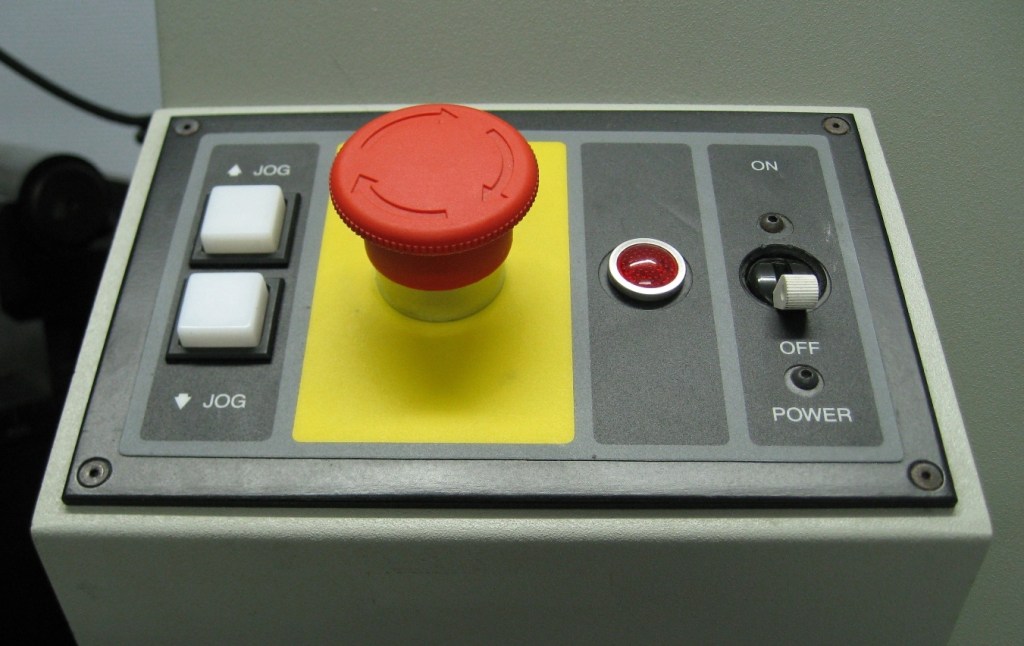
3. Emergency stops
The FactoryBox has a button on its control panel, labeled “E-stop”, short for emergency stop.
Emergency stops, also known as a kill switche, are designed to quickly stop a machine or production process whenever an emergency occurs or the equipment cannot be stopped safely using its normal controls.
Their primary purpose is to minimize the risk of injury to personnel and prevent damage to machinery.
Emergency stop buttons are typically large, red, mushroom-shaped buttons that are easy to identify and reach quickly. Depending on the safety requirements, they often remain locked after activation and can only be reset by authorized personnel using a key, a specific unlocking procedure, or another controlled method. You can read more about them on Wikipedia: E-stops
4. Protective measures
When there are moving parts, robots or machinery, that can seriously injure people upon colission/contact, safety measures need to be established.
They are split intwo two main groups.
4.1 Guards
Guards prevent access to hazardous areas by means of a physical barrier. Their purpose is to ensure that workers cannot accidentally enter the operating space of dangerous machinery while it is running.
Physical guards are particularly important for machines and robots that perform fast or forceful movements. For example, a robot carrying heavy workpieces could seriously injure a person entering its working area, while rotating machine tools or spinning shafts could catch clothing or body parts and cause severe or even fatal injuries. By preventing physical access, guards eliminate the possibility of contact with these hazards during normal operation.
In the FactoryBox, this concept is represented by the transparent acrylic barriers surrounding the machining center and one side of the robot station. The clear material allows learners to observe the manufacturing process while still illustrating the principle of separating people from hazardous machine movements. This demonstrates that effective safety measures do not necessarily obstruct visibility but instead create a safe working environment without limiting process monitoring.


4.2 Protective Devices
Unlike guards, protective devices do not physically block access. Instead, they monitor the surrounding area and automatically stop or slow down a machine whenever a person enters a hazardous zone. These devices are especially important in applications where operators must regularly access the machine or where humans and robots work together in a shared workspace.
Common examples include light curtains, laser scanners, safety mats, vision systems, and safety-rated distance sensors. These technologies continuously monitor the protected area and trigger a safe stop before a collision or injury can occur. Depending on the application, machines may stop completely or switch into a reduced-speed collaborative mode.
The FactoryBox demonstrates this principle using a distance sensor installed next to the opening in the protective barrier. The sensor can be programmed to function similarly to a light barrier, detecting when someone enters the machining area while the machine is operating. If an intrusion is detected, the system can trigger an alarm or stop the production process, illustrating the basic operating principle of presence detection systems.
It is important to note that real industrial protective devices are considerably more sophisticated. Rather than monitoring a single point, they typically protect an entire area or volume and are designed to meet strict functional safety standards. Multiple redundant sensors and certified safety controllers are often required to ensure reliable operation even in the event of a component failure.
Together, guards and protective devices form complementary layers of protection. Guards prevent access whenever possible, while protective devices provide additional safety in situations where human interaction with the production system is necessary. This layered approach is a fundamental principle of modern industrial machine safety.


5. Alarm signals
In case of emergency there are multiple ways of signaling required. Those often include, flashing red or orange lights, sounds like continous beeping and or recorded warning messages.
Emergency doors can light up, Machines be shut down or automatic system responses like sprinklers be activated.
Depending on the type of factory or emergency, automated calls to the police, fire station or paramedics will be triggered.
In FactoryBox there are two red LEDs and a buzzer, which can be used to create an alarm, e.g. if the sensor at the machining sensor gets tripped while the CNC machine is running.


6. Emergency Escape Routes
There can always be accidents, a fire or other emergencys that require a factory to be evacuated.
To ensure that people can leave the danger zone unhindered, escape routes, emergency exits and emergency escape hatches must be kept clear at all times and must not be obstructed.
They are usually markes with Exit signs and there are plans on each level/important area that show the nearest exit and other important information.
Usually emergency exits are marked with green signs, modern versions can also light up with green flashing signals.

https://www.securityalarm.com/blog/does-my-business-need-a-fire-escape-plan/
It is difficult to represent proper emergency routes in the FactoryBox. However, while the storage area is physically seperated trough conveyor belts, the assembly line and the Machining area each have unobstruted pathways to the nearest exit.